
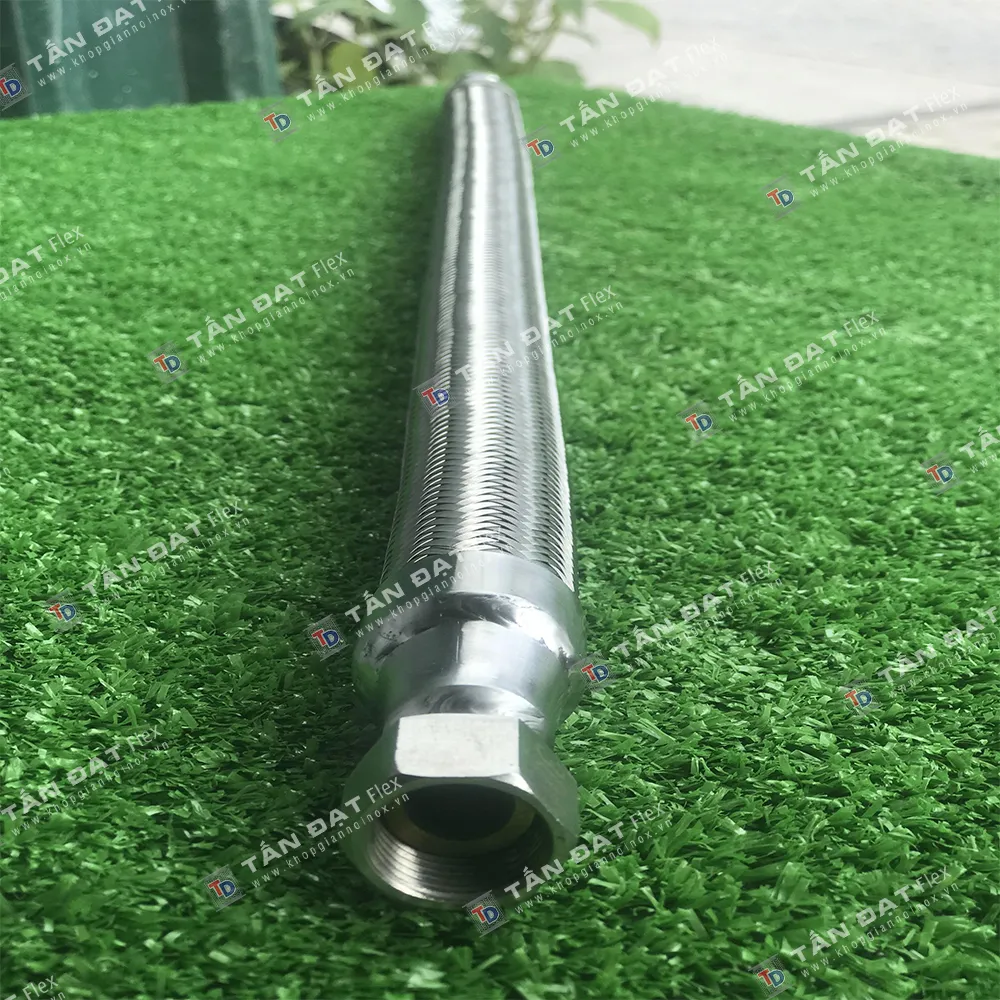
Learn in detail about the structure, technical specifications, and characteristics of various types of stainless steel flexible hoses with female cone seat threads, flat threads, and unions used in industrial applications.
General technical structure of industrial stainless steel flexible hoses
In technological piping systems, handling vibration and thermal expansion is a core challenge for design engineers. The metal flexible hose product line manufactured by Tan Dat Flex meets these requirements through the tight integration of material components.
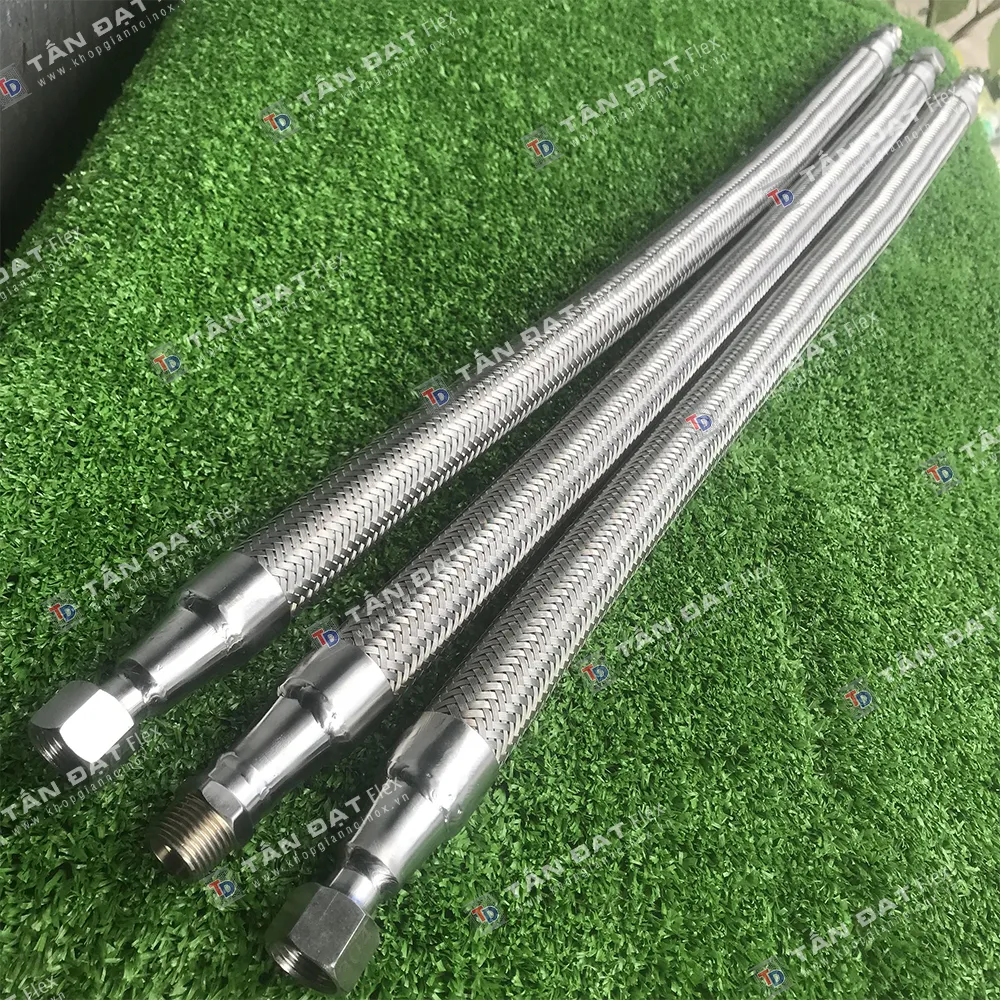
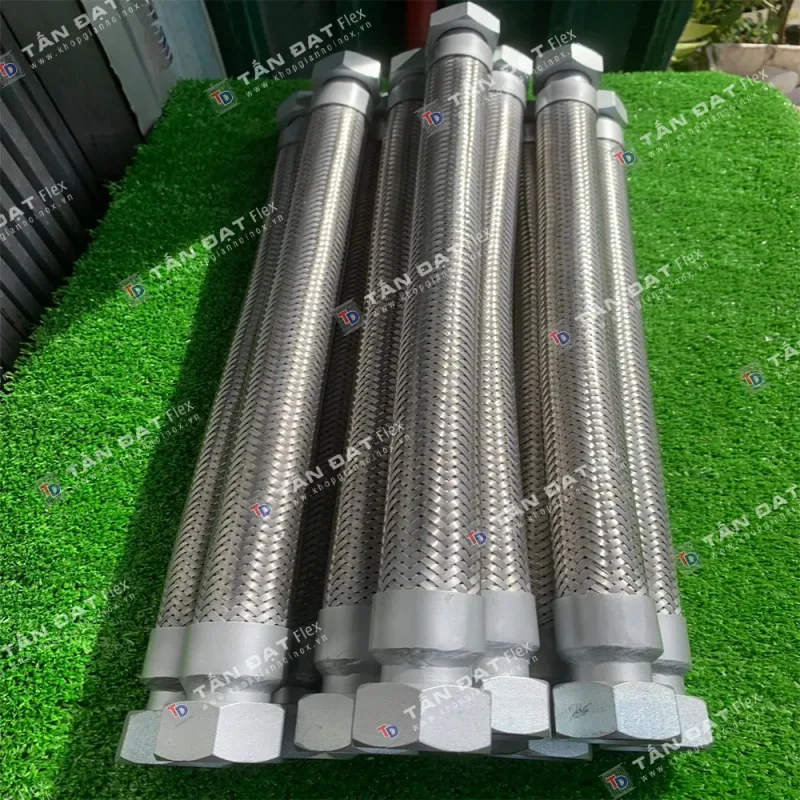
The main body utilizes thin-walled corrugated hoses fabricated via hydraulic pressure from stainless steel grades such as SUS 304, SUS 316, or SUS 321. This corrugated profile provides flexible bending capabilities and high elasticity. To withstand high operating pressures and prevent blistering, a braided stainless steel wire layer is wrapped around the exterior to act as tensile reinforcement. Depending on the actual requirements of each installation site, engineers can flexibly choose different types of threaded connections.
Analysis of three common threaded connection types: Female cone seat thread, flat thread, and union
Selecting the correct threaded connection type directly determines the tightness and service life of the entire piping line. Below are the technical characteristics of each type for engineers to reference during design:
- Female cone seat thread: The sealing mechanism is based on the metal-to-metal contact surface. This design is highly stable under temperature and pressure, making it an optimal solution for steam or industrial gas pipelines.
- Flat thread (straight thread): Uses an additional gasket to seal between two flat surfaces. This type allows for quick assembly and installation, suitable for water supply and drainage systems or medium-pressure compressed air lines.
- Union: A flexible assembly/disassembly solution that allows engineers to perform periodic maintenance easily without twisting the hose body during tightening. This is a useful technical choice for tight spaces requiring quick operations.
Basic technical specifications and selection standards
To ensure the flexible hose operates durably, the purchasing process must be based on dimensional parameters and actual medium conditions at the facility.
| Technical criteria | Common standards | Application notes |
|---|---|---|
| Hose body length | 200, 300, 400, 500, 600, 800, 1000 mm | Can be custom-made according to specific drawing requirements |
| Working medium | Water, steam, oil, compressed air, chemicals, LPG | Depends on stainless steel grade (SUS 304/316) and gasket type |
| Operating characteristics | Vibration absorption, thermal compensation | Reduces stress on pumps, valves, and boilers |
Important notes for installation and maintenance of threaded stainless steel flexible hoses
Even when using high-quality materials, errors during assembly can lead to leaks or rupture of the corrugated hose. Engineers and construction teams must adhere to the following principles:
- Avoid twisting (torsion) the hose throughout the process of tightening the threaded ends or during operation. Always keep the hose axis on a single bending plane.
- Comply with the minimum bending radius recommended by the manufacturer to avoid deforming the corrugations.
- Periodically check the tightness of the threaded connections, especially in systems with high vibration amplitudes such as air compressors or high-pressure pumps.
Contact for technical consultation and custom fabrication
CÔNG TY TNHH SX TM VÀ DỊCH VỤ CƠ KHÍ TẤN ĐẠT (Tan Dat Flex) specializes in manufacturing and supplying high-quality stainless steel flexible hoses and expansion joints. For detailed advice on technical specifications, choosing the appropriate thread type, or placing orders for custom fabrication according to your drawings, please contact:
Workshop address: D20/26F2 Vo Van Van, Hamlet 4A, Tan Vinh Loc Commune, Ho Chi Minh City
Hotline/Zalo: 0906 304 114
Email: khopgiannoinox.vn@gmail.com
Frequently asked questions
When should stainless steel 321 flexible hoses be used?
Do stainless steel flexible hoses require a braided mesh?
Related articles
304 stainless steel braided corrugated hose with iron threaded ends
Discover the features and applications of 304 stainless steel braided corrugated hoses with iron threaded ends. Learn…
Heat-resistant stainless steel braided hose: construction and uses
Learn in detail about high-temperature braided stainless steel flexible hoses provided by Tan Dat: constructed from…
Steel female cone seat thread stainless steel flexible hose: applications and selection tips
Learn in detail about steel female cone seat thread stainless steel flexible hoses, their structure, practical…